Skip to content
Products From Scrap 2026: How Scrap Materials Become Useful Products
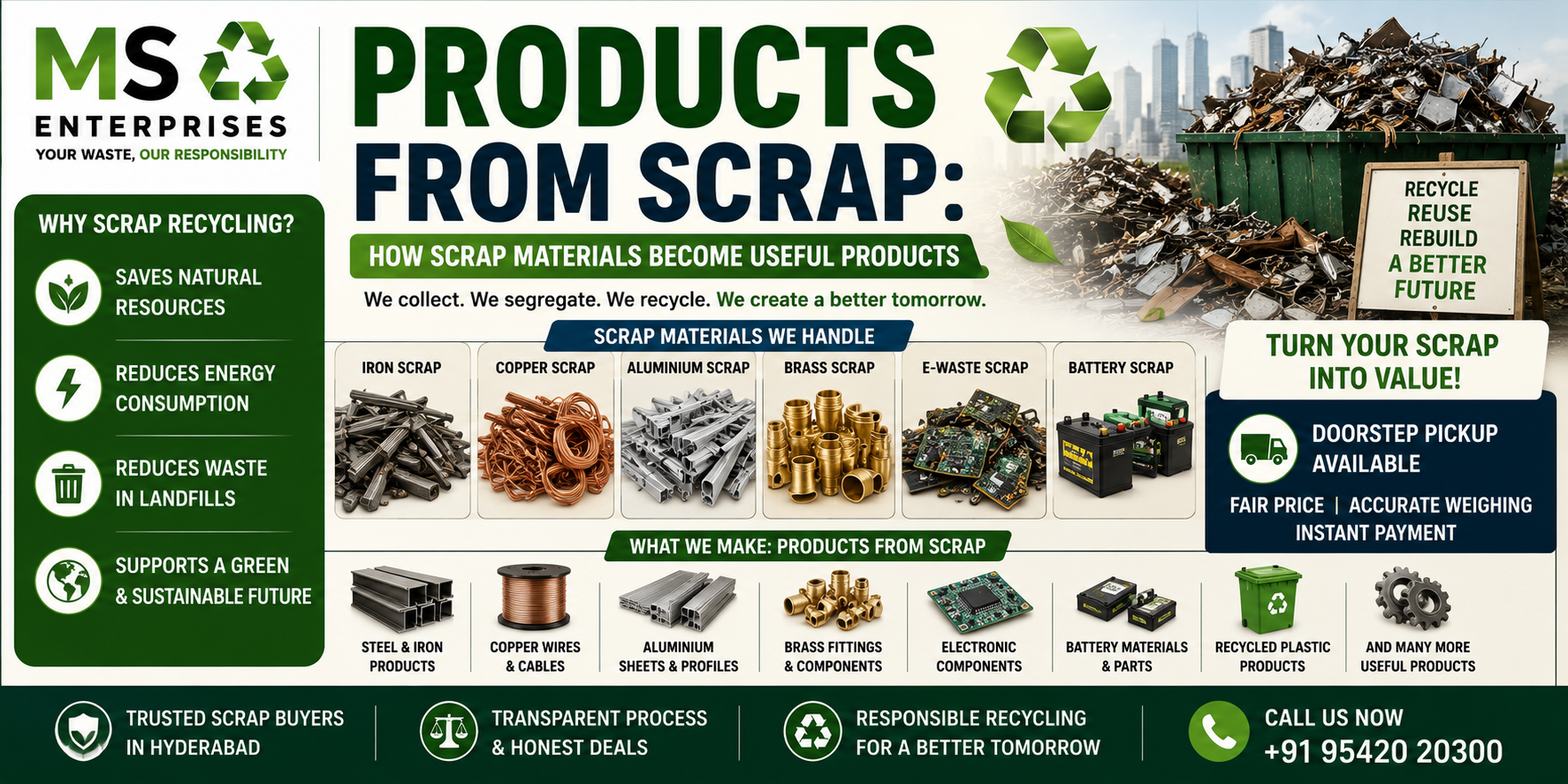
Products from scrap can include recycled metals, components, industrial materials and other products created from recovered materials.
Copper scrap, aluminium scrap, brass scrap and iron scrap can all enter recycling streams where they are sorted and processed for further use. Electronic scrap and battery scrap can also contain materials that require specialized handling and recovery.
For households, businesses, factories, offices and commercial establishments, selling recyclable scrap to a responsible scrap buyer is one way to ensure that useful materials do not simply end up as unmanaged waste.
MS Enterprises is a Hyderabad-based scrap buyer that handles ferrous and non-ferrous scrap, electronic scrap, battery scrap, automobile scrap, IT furniture scrap, wooden scrap and other categories. The company states that collected materials are segregated and directed toward appropriate recycling, reuse or processing channels.
What Are Products From Scrap?
Products from scrap are materials, components or new products created using recovered materials from discarded or unwanted items.
Instead of treating every discarded item as useless, recycling allows valuable materials to be recovered.
For example:
- Copper scrap can become recycled copper material.
- Aluminium scrap can be processed into recycled aluminium.
- Brass scrap can return to metal manufacturing.
- Iron scrap can be melted and used in new steel and iron products.
- Electronic scrap can provide recoverable metals and components.
- Battery scrap can enter specialized recycling processes.
- Old automobile parts can contribute metals and other recoverable materials.
The exact final product depends on the type, quality, purity and processing method of the scrap.
This is why scrap recycling is more than simply collecting waste. It is part of a larger material recovery system.
How Does Scrap Become a New Product?
The process generally involves several stages.
1. Collection
Scrap materials are collected from homes, offices, factories, shops, warehouses and commercial locations.
2. Sorting
Different materials are separated according to their type.
For example:
- Copper
- Brass
- Aluminium
- Iron
- Steel
- Plastic
- Paper
- Electronic components
3. Inspection
The material may be inspected for quality, contamination, mixed materials and other characteristics.
4. Dismantling
Large equipment, machines and electronic products may need to be dismantled to separate their components.
5. Processing
Depending on the material, scrap may be compressed, shredded, separated, cleaned or prepared for further processing.
6. Recycling
Recovered materials are sent into suitable recycling or manufacturing channels.
7. Manufacturing
The recovered material can become part of new products.
MS Enterprises describes a process involving collection, segregation and recycling, with metal and other materials being directed toward appropriate reuse and industrial processing.
What Products Can Be Made From Scrap?
The answer depends heavily on the material.
| Scrap Material | Possible Recycled Material / Product Applications |
|---|---|
| Copper Scrap | Copper products, wires, components and industrial material |
| Aluminium Scrap | Aluminium sheets, components, profiles and other products |
| Brass Scrap | Brass components, fittings and industrial products |
| Iron Scrap | Steel and iron products |
| Steel Scrap | Construction and engineering products |
| Battery Scrap | Recovered battery materials through specialized recycling |
| Electronic Scrap | Recovered metals and electronic materials |
| Automobile Scrap | Recovered metal, parts and recyclable materials |
These are broad examples rather than guarantees that a particular scrap item will become a particular product.
The recycling route depends on material composition, quality, contamination and the facilities processing it.
Why Are Products From Scrap Important?
The idea behind products from scrap is simple: materials do not necessarily have to become waste after their first use.
A metal component that has reached the end of its useful life can potentially become a raw material for another manufacturing process.
This can help:
- Reduce material waste
- Recover valuable resources
- Support recycling industries
- Reduce dependence on virgin raw materials
- Keep recyclable materials in circulation
- Create economic value from discarded materials
For this reason, responsible scrap collection is an important part of a circular approach to materials.
What Is Copper Scrap?
Copper scrap is discarded or surplus copper material collected for recovery and recycling.
Common sources include:
- Copper wires
- Electrical cables
- Copper pipes
- Motor windings
- Electrical components
- Industrial machinery
- Air-conditioning components
- Plumbing materials
- Transformers and electrical equipment
MS Enterprises lists copper scrap and copper pipes among its ferrous and non-ferrous scrap categories and also handles wires and cables through its electronic scrap services.
<a href=”https://msscrapbuyers.com/ferrous-non-ferrous-scrap/”>Copper & Non-Ferrous Scrap</a>
What Products Are Made From Copper Scrap?
Copper is a highly useful industrial metal, so recovered copper can return to manufacturing streams.
Depending on the recycling process, recovered copper can be used in applications involving:
- Electrical components
- Copper wires
- Cables
- Pipes
- Industrial components
- Engineering products
- Electrical equipment
The quality of the recovered copper matters.
Clean, separated copper generally has different characteristics from mixed or contaminated copper-containing scrap.
That is one reason why scrap sorting is important before recycling.
What Is Copper Wire Scrap?
Copper wire scrap consists of unwanted or discarded wires and cables containing copper.
It can come from:
- Electrical installations
- Construction projects
- Demolition
- Factories
- Offices
- Old appliances
- Electrical equipment
- Telecommunications equipment
- Machinery
Copper wire scrap can vary significantly in value depending on the type of wire, copper content, insulation and overall condition.
Bare copper and insulated copper wire are not necessarily valued in the same way.
What Determines Copper Wire Scrap Price?
People frequently search for copper wire scrap price because copper is a valuable recyclable metal.
However, there is no single permanent copper wire scrap price that applies to every transaction.
The price can depend on:
- Copper purity
- Wire type
- Insulation
- Weight
- Quantity
- Contamination
- Market conditions
- Location
- Processing requirements
- Current demand
Therefore, anyone searching for copper wire scrap price per kg should request a current quotation based on the actual material.
A price published for one type of copper wire should not automatically be applied to another type.
What Is Copper Scrap Price Per Kg?
Copper scrap price per kg changes according to market conditions and material quality.
For example, two sellers may have:
- Different copper purity
- Different wire insulation
- Different quantities
- Different levels of contamination
- Different material types
As a result, their final quotations may differ.
For an accurate current quotation, it is better to provide photographs, approximate weight, material type and pickup location to a local scrap buyer.
MS Enterprises states that it offers competitive prices and evaluates scrap as part of its buying process.
What Is Aluminium Scrap?
Aluminium scrap is discarded aluminium collected for reuse and recycling.
Common sources include:
- Aluminium sheets
- Aluminium pipes
- Window frames
- Door frames
- Industrial components
- Machinery parts
- Vehicle components
- Cans
- Construction materials
- Household items
MS Enterprises lists aluminium scrap and aluminium pipe scrap under its ferrous and non-ferrous scrap categories.
What Products Can Be Made From Aluminium Scrap?
Recovered aluminium can be processed and used in manufacturing applications such as:
- Aluminium profiles
- Sheets
- Components
- Automotive parts
- Industrial products
- Construction materials
- Packaging-related products
One of the advantages of aluminium recycling is that the metal can be recovered and reused without simply treating the original product as permanent waste.
What Determines Prices for Aluminium Scrap?
Searches for prices for aluminum scrap are common because aluminium scrap rates can change over time.
Important factors include:
- Aluminium grade
- Purity
- Alloy
- Weight
- Quantity
- Contamination
- Mixed materials
- Market demand
- Local buying conditions
For example, clean aluminium may be evaluated differently from aluminium mixed with plastic, steel or other materials.
Therefore, a seller should provide accurate information before expecting a final quotation.
What Is Brass Scrap?
Brass scrap consists of discarded materials containing brass, an alloy primarily made from copper and zinc.
Common brass scrap sources include:
- Brass fittings
- Valves
- Plumbing components
- Electrical components
- Hardware
- Industrial parts
- Decorative items
- Machinery components
MS Enterprises lists brass scrap under its ferrous and non-ferrous scrap services.
What Products Can Be Made From Brass Scrap?
Recycled brass can be used in manufacturing and industrial applications involving:
- Fittings
- Valves
- Hardware
- Engineering components
- Plumbing products
- Electrical components
- Decorative products
As with copper and aluminium, the value of brass scrap depends on its composition, quality and market conditions.
What Is the Price of Brass Per Kilo?
The price of brass per kilo is not fixed permanently.
Brass scrap rates can vary based on:
- Brass grade
- Copper and zinc composition
- Cleanliness
- Mixed materials
- Quantity
- Current market conditions
- Local demand
A seller should therefore avoid relying on an old online rate when selling brass scrap.
The best way to know the current price is to contact a scrap buyer and provide details about the actual material.
What Is Iron Scrap?
Iron scrap is discarded iron-containing material collected for recycling.
Common examples include:
- Iron sheets
- Iron rods
- Machinery
- Old gates
- Structural components
- Pipes
- Industrial equipment
- Metal frames
- Fabrication waste
MS Enterprises lists iron scrap as part of its ferrous and non-ferrous scrap categories.
<a href=”https://msscrapbuyers.com/what-we-take/”>See What MS Enterprises Takes</a>
What Products Can Be Made From Iron Scrap?
Iron and steel scrap can be recovered and processed for use in manufacturing and construction-related applications.
Recycled ferrous material can contribute to products such as:
- Steel components
- Construction materials
- Machinery components
- Metal structures
- Engineering products
- Industrial products
The exact application depends on the grade and processing route.
What Determines Iron Scrap Price?
People often search for iron scrap price when planning to sell old machinery, fabrication waste or household metal.
Iron scrap prices can vary according to:
- Type of iron
- Grade
- Weight
- Quantity
- Rust
- Contamination
- Mixed materials
- Local market conditions
- Transportation requirements
Heavy industrial scrap may also require different handling compared with small household quantities.
What Is Battery Scrap?
Battery scrap refers to used, damaged or end-of-life batteries that require appropriate collection, handling and recycling.
Battery scrap can include:
- Lead-acid batteries
- UPS batteries
- Inverter batteries
- Lithium-ion batteries
- Automotive batteries
- Backup power batteries
MS Enterprises lists lead-acid battery scrap, lithium-ion battery scrap, UPS scrap, inverter scrap, batteries and related categories among its services.
<a href=”https://msscrapbuyers.com/battery-scrap/”>Battery Scrap Services</a>
What Determines Battery Scrap Price?
Searches for battery scrap price can be misleading if they do not specify the battery type.
Different batteries can contain different materials and have different recycling requirements.
The value can depend on:
- Battery type
- Weight
- Chemistry
- Condition
- Quantity
- Recoverable materials
- Current market conditions
- Transportation and handling
Never assume that the rate for a lead-acid battery automatically applies to a lithium-ion battery.
Battery recycling should also be handled responsibly because damaged batteries can present safety risks.
Products From Electronic Scrap
Electronic scrap is another major source of recoverable material.
Examples include:
- Computers
- Laptops
- Mobile phones
- Televisions
- Monitors
- Circuit boards
- Cables
- Wires
- Printers
- Networking equipment
- Electrical panels
- Switches
- Transformers
MS Enterprises lists electronic scrap categories including computers, TVs, phones, wires, cables, circuit boards, electrical panels, switches, transformers, refrigerators, washing machines and other electronic equipment.
<a href=”https://msscrapbuyers.com/electronic-scrap/”>Electronic Scrap Recycling</a>
What Products Can Come From Electronic Scrap?
Electronic scrap can contain recoverable:
- Copper
- Aluminium
- Steel
- Other metals
- Plastics
- Electronic components
After appropriate collection and processing, recoverable materials can return to relevant manufacturing and recycling streams.
However, electronic waste should not be dismantled casually because some equipment can contain hazardous or sensitive components.
Professional handling is preferable for large quantities and specialized electronic waste.
Products From Automobile Scrap
End-of-life vehicles contain a variety of recoverable materials.
Automobile scrap may include:
- Steel
- Iron
- Aluminium
- Copper
- Batteries
- Electrical components
- Engines
- Gearboxes
- Wheels
- Other reusable parts
MS Enterprises lists automobile scrap, end-of-life vehicle recycling, car scrap, bike scrap, engine scrap, gearbox scrap and other vehicle categories among its services.
<a href=”https://msscrapbuyers.com/automobile-scrap/”>Automobile Scrap Services</a>
Products From Scrap: Material Recovery Table
The following table provides a simple overview of how common scrap categories can contribute to material recovery.
| Scrap Type | Common Sources | Potential Recovered Material |
|---|---|---|
| Copper Scrap | Wires, pipes, machinery | Copper |
| Aluminium Scrap | Frames, sheets, machinery | Aluminium |
| Brass Scrap | Valves, fittings, hardware | Brass |
| Iron Scrap | Machinery, structures, fabrication | Iron/steel |
| Battery Scrap | Vehicles, UPS, inverters | Recoverable battery materials |
| Electronic Scrap | Computers, TVs, cables | Metals and components |
| Automobile Scrap | Cars, bikes, trucks | Metals and reusable components |
The final recovery route depends on the composition and condition of the material.
Scrap Price vs Scrap Value: What Is the Difference?
A common mistake is assuming that every scrap item has a simple price per kilogram.
In reality, scrap value can involve more than weight.
For example, a copper cable may contain copper but also insulation.
A refrigerator may contain several different materials.
A vehicle contains steel, aluminium, copper, plastics and other components.
Therefore, the buyer may first need to evaluate the material before providing a final price.
This is especially important for mixed scrap.
Why Scrap Prices Change
Scrap prices are influenced by multiple factors.
These can include:
- Global commodity markets
- Industrial demand
- Manufacturing activity
- Availability of recycled material
- Material quality
- Local demand
- Transportation costs
- Quantity
- Processing requirements
This is why keywords such as copper scrap price per kg, iron scrap price, battery scrap price and price of brass per kilo can have different answers at different times.
A useful SEO article should therefore explain the factors behind pricing rather than publish a potentially outdated number.
How to Get the Best Value for Scrap
If you want to maximize the value of your recyclable materials, consider these steps.
Separate Materials
Keep copper, brass, aluminium and iron separate when possible.
Remove Unnecessary Contamination
Clean and separated materials are generally easier to evaluate.
Identify the Material
Know whether you are selling copper, brass, aluminium, iron or mixed scrap.
Estimate the Quantity
Provide approximate weight or quantity.
Take Photographs
Photos help a buyer understand the material before pickup.
Compare Quotations
For large quantities, sellers may compare quotations from multiple buyers.
Choose a Transparent Buyer
Ask about weighing, material evaluation and payment before completing the transaction.
MS Enterprises highlights accurate weighing, doorstep pickup and quick payment as part of its service offering.
How to Sell Copper Scrap in Hyderabad
If you have copper scrap in Hyderabad, start by identifying the material.
For example:
Copper wires
Copper pipes
Motor copper
Cable scrap
Mixed copper material
Then provide the buyer with:
- Approximate quantity
- Material type
- Condition
- Pickup location
- Photos if available
MS Enterprises is based in Madhapur, Hyderabad, and provides scrap collection services. Its website lists copper scrap, copper pipes, wires and cables among its scrap categories.
How to Sell Aluminium Scrap in Hyderabad
Aluminium scrap can come from homes, offices, factories, construction sites and commercial businesses.
Common aluminium scrap includes:
- Aluminium frames
- Pipes
- Sheets
- Machinery components
- Industrial scrap
- Mixed aluminium materials
Separate aluminium from steel and other metals where possible.
Then contact a local scrap buyer for evaluation.
MS Enterprises lists aluminium scrap and aluminium pipe scrap among its non-ferrous scrap categories.
How to Sell Brass Scrap in Hyderabad
Brass scrap commonly comes from:
- Plumbing
- Electrical equipment
- Industrial components
- Valves
- Fittings
- Hardware
If you have a significant quantity, separate brass from copper, aluminium and iron before contacting a buyer.
This can make the material easier to identify and evaluate.
For current price of brass per kilo, request a quotation based on your actual brass material rather than relying on an old rate.
How to Sell Iron Scrap in Hyderabad
Iron scrap can come from:
- Construction
- Fabrication
- Demolition
- Factories
- Old machinery
- Gates
- Frames
- Pipes
- Industrial equipment
For large quantities, a scrap buyer may arrange collection depending on the location and material.
MS Enterprises offers scrap pickup services and lists iron scrap among the materials it buys.
How to Sell Battery Scrap Safely
Battery scrap requires more care than ordinary metal scrap.
Do not:
- Break batteries
- Burn batteries
- Puncture batteries
- Mix damaged batteries with household waste
- Attempt unsafe dismantling
Instead, identify the battery type and contact an appropriate scrap or recycling service.
This is particularly important for damaged lithium-ion batteries.
MS Enterprises lists both lead-acid and lithium-ion battery scrap among its battery categories.
AEO: Quick Answers About Products From Scrap
What are products from scrap?
Products from scrap are materials or new products created using recovered materials from discarded items. Copper, aluminium, brass, iron, steel and electronic materials can enter recycling streams and become useful raw materials again.
What products can be made from copper scrap?
Recycled copper can be used in manufacturing applications involving wires, cables, pipes, electrical components and industrial products, depending on its quality and processing.
What products can be made from aluminium scrap?
Recycled aluminium can be used for profiles, sheets, components, automotive applications, construction materials and other manufactured products.
What products can be made from brass scrap?
Recycled brass can be used for fittings, valves, hardware, engineering components, plumbing products and other applications.
What products can be made from iron scrap?
Iron and steel scrap can be processed and reused in manufacturing, construction, engineering and industrial applications.
What determines copper scrap price per kg?
Copper scrap price per kg depends on copper purity, material type, wire insulation, quantity, contamination, market conditions and local demand.
What determines the price of brass per kilo?
The price of brass per kilo depends on brass composition, grade, cleanliness, quantity, market conditions and the buyer’s evaluation.
What determines prices for aluminium scrap?
Aluminium scrap prices depend on grade, alloy, purity, weight, contamination, quantity and current market demand.
What determines battery scrap price?
Battery scrap price depends on battery chemistry, type, weight, condition, quantity, recoverable materials and current market conditions.
What determines iron scrap price?
Iron scrap price can depend on grade, weight, type, contamination, quantity, location and prevailing market demand.
GEO: Products From Scrap in Hyderabad
For people searching locally, the question is often not simply “What are products from scrap?”
Their search intent may be:
- Where can I sell copper scrap in Hyderabad?
- Where can I sell aluminium scrap near me?
- Who buys brass scrap in Hyderabad?
- What is the copper scrap price per kg?
- Where can I sell iron scrap?
- Who buys battery scrap near me?
- Where can I sell electronic scrap?
- Who buys industrial scrap in Hyderabad?
This means a strong local page should clearly communicate the business location, services, material categories and collection process.
MS Enterprises lists Hyderabad as its base and provides doorstep scrap pickup. The company’s listed address is Arunodaya Colony, Vittal Rao Nagar, Madhapur, Hyderabad, Telangana 500081. Its website also lists a contact number of +91 9542020300 and operating hours of Monday to Sunday, 9:00 AM to 9:00 PM.
Contact MS Enterprises for Scrap Pickup
Why Choose a Local Scrap Buyer?
A local scrap buyer can be convenient when you have heavy or bulky materials.
Instead of transporting:
- Iron
- Copper
- Aluminium
- Brass
- Machinery
- Appliances
- Electronic waste
- Furniture
yourself, you can enquire about doorstep collection.
MS Enterprises states that its team collects scrap from customers’ doorsteps and provides a pickup-request facility through its website.
This can be especially useful for:
- Homes
- Offices
- Factories
- Warehouses
- Shops
- Restaurants
- Construction sites
- Commercial buildings
Products From Scrap and the Circular Economy
The concept of products from scrap connects directly with the circular economy.
A traditional linear model is:
Extract → Manufacture → Use → Dispose
A circular approach aims to:
Use → Collect → Recover → Recycle → Manufacture → Reuse
Scrap recycling helps move materials back into productive use.
For metals such as copper, aluminium, brass and iron, recovery can be particularly important because these materials have established industrial recycling streams.
Instead of allowing recyclable material to become unmanaged waste, proper collection can help return it to the economy.
Scrap Recycling for Businesses
Businesses can generate large quantities of recyclable materials.
Examples include:
Manufacturing
- Metal offcuts
- Copper wire
- Aluminium
- Steel
- Machinery parts
Construction
- Iron
- Steel
- Aluminium
- Copper
- Pipes
Offices
- Electronic waste
- Computers
- Cables
- Furniture
Retail
- Packaging
- Appliances
- Metal
- Electronic equipment
Factories
- Industrial machinery
- Metal components
- Electrical scrap
- Batteries
A structured scrap-management system can make it easier to sort and sell these materials.
Scrap Recycling for Households
Households also generate recyclable scrap.
Examples include:
- Old wires
- Aluminium items
- Brass fittings
- Iron furniture
- Old appliances
- Batteries
- Electronic devices
- Newspapers
- Cardboard
Instead of allowing these items to accumulate, homeowners can separate them and contact a scrap buyer.
MS Enterprises states that it collects residential and commercial scrap and offers doorstep collection.
How MS Enterprises Handles Different Scrap Categories
MS Enterprises operates as a multi-category scrap buyer rather than focusing only on one metal.
Its website lists:
- AC scrap
- Automobile scrap
- Battery scrap
- Electronic scrap
- Ferrous and non-ferrous scrap
- IT furniture scrap
- Wooden scrap
- Computer and IT scrap
This can be useful when a customer has mixed scrap.
For example, an office renovation may generate:
Copper cables + aluminium partitions + iron furniture + electronic equipment + wooden furniture
Instead of searching for a separate buyer for every category, a multi-category scrap buyer can potentially simplify the collection process.
How to Prepare Mixed Scrap for Collection
If you have several types of scrap, organize them before the buyer arrives.
Category 1: Copper
Keep copper wires, pipes and copper components together.
Category 2: Aluminium
Separate aluminium frames, sheets and pipes.
Category 3: Brass
Keep brass fittings, valves and components separate.
Category 4: Iron and Steel
Group heavy ferrous materials together.
Category 5: Electronic Scrap
Keep computers, cables, appliances and electronic equipment together.
Category 6: Batteries
Keep batteries separate and identify their type.
This organization can make evaluation and collection more efficient.
Final Guide to Products From Scrap
The idea behind products from scrap is that discarded materials can have a second life.
Copper can return to manufacturing.
Aluminium can be recovered and reused.
Brass can become material for new components.
Iron and steel can return to industrial production.
Electronic scrap can provide recoverable metals and components.
Batteries can enter specialized recycling streams.
The important part is responsible collection, proper segregation and suitable processing.
If you have scrap to sell, don’t judge its value simply by appearance. A pile of old wires, pipes, metal components or electronic equipment may contain materials that can be recovered.
Frequently Asked Questions
Is scrap actually useful?
Yes. Many scrap materials contain recoverable metals, plastics, paper or other materials that can be reused or recycled.
Is copper scrap valuable?
Copper is a widely used industrial metal and copper scrap can have recycling value. The actual price depends on the type and quality of the material and current market conditions.
Is aluminium scrap recyclable?
Yes. Aluminium is commonly recycled and can be processed into material for new manufacturing applications.
Is brass scrap recyclable?
Yes. Brass scrap can be collected, processed and returned to manufacturing streams.
Can iron scrap be reused?
Yes. Iron and steel scrap can be processed and reused in industrial and manufacturing applications.
Can battery scrap be recycled?
Yes, but batteries require appropriate handling because different battery chemistries require different recycling processes.
Does copper wire have the same price as copper pipe?
Not necessarily. Different copper scrap categories can have different material compositions, purity levels and processing requirements.
Why does scrap price change?
Scrap prices can change because of market demand, material quality, commodity prices, quantity, location and processing requirements.
Should I separate copper and aluminium?
Yes. Keeping different materials separate can make identification and evaluation easier.
Can I sell mixed scrap?
Depending on the buyer and material, mixed scrap may be accepted. However, separating materials can make the evaluation more straightforward.
Conclusion: From Scrap to Useful Products
Products from scrap demonstrate that waste can become a valuable source of recovered materials.
Copper scrap, copper wire scrap, aluminium scrap, brass scrap and iron scrap can all enter recycling systems and contribute to new manufacturing processes. Battery scrap and electronic scrap can also contain recoverable materials but require appropriate handling.
If you’re searching for copper scrap price per kg, copper wire scrap price, price of brass per kilo, prices for aluminium scrap, battery scrap price or iron scrap price, remember that scrap rates are not permanently fixed. The final value depends on material type, quality, quantity, contamination and prevailing market conditions.
For accurate quotations, provide the scrap buyer with details about your material, approximate quantity, photographs and pickup location.
For customers in Hyderabad, MS Enterprises buys multiple categories of scrap, including copper, aluminium, brass, iron, battery, electronic, automobile and IT scrap. The company offers doorstep collection and describes its process as involving segregation, evaluation, recycling and reuse.