Skip to content

Every year, thousands of Indian households and businesses create construction offcuts, worn-out car parts, damaged appliances, and outdated office furniture. Instead of ending up in a warehouse or landfill, this material might be sold to scrap metal recyclers and recycled back into raw materials for new products.
If you have never sold garbage before, the procedure could be perplexing.
How is the cost determined? What are the most valuable metals? Is it safe for someone to pick it up from your house or place of business? This book provides you with a useful checklist for selecting a trustworthy recycler and explains how scraps and metal recycling actually operate.
What Do Scrap Metal Recyclers Actually Do?
Scrap metal recyclers collect used metal products, classify, grade, and get them ready for further processing into new raw materials. They operate as an intermediary between the individual disposing of the metal and the manufacturers, foundries, and mills that melt and reuse it.
A typical recycler handles several stages of this chain:
- Gathering waste from residences, workplaces, manufacturing facilities, and building sites.
- Weighing and classifying the material according to the purity and kind of metal.
- Distinguishing between non-ferrous (copper, aluminium, brass) and ferrous (iron and steel) metals.
- Dismantling, shredding or baling bigger objects to get them ready for transportation
- Selling the sorted material onward to smelters and processing units.
Working with an established recycler such as MS Enterprises means this entire chain happens under one roof, with a single point of contact from pickup to payment.
Why Choose Professional Scrap Metal Recyclers Over a Local Kabadiwala?
The precise weighing, documented price, and proper treatment of hazardous components that professional recyclers offer cannot be guarantyd by an unofficial local buyer. Furthermore, a reputable recycling business has the tools and authorisation necessary to safely handle larger quantities of speciality rubbish like batteries or e-waste.
This is a broad comparison of the two options:
| Factor | Local Kabadiwala | Professional Scrap Metal Recyclers |
| Weighing accuracy | Often approximate | Calibrated scales, transparent process |
| Price transparency | Negotiated, inconsistent | Based on current market rates |
| Bulk or industrial scrap | Usually not equipped | Designed for large volumes |
| Hazardous items (batteries, e-waste) | Rarely handled correctly | Processed through compliant channels |
| Pickup service | Limited or informal | Scheduled doorstep pickup |
| Payment record | Verbal, no receipt | Receipt provided |
For a one-off sale of a few kilos of iron, a local buyer may be convenient. A professional recycler is the safer and more lucrative option for anything involving automobiles, appliances, batteries, or huge industrial debris.
What Kinds of Metal Are Available for Sale to Recyclers of Scrap Metal?
Both ferrous metal which is magnetic and contains iron and non-ferrous metal which is devoid of iron and usually sells for more money per kilogram can be sold. One of these two main categories includes the majority of scrap from homes and businesses.
| Category | Common Examples | Typical Source |
| Ferrous metal | Iron, steel, HMS scrap, MS pipes, GI pipes | Structures, machinery, appliances |
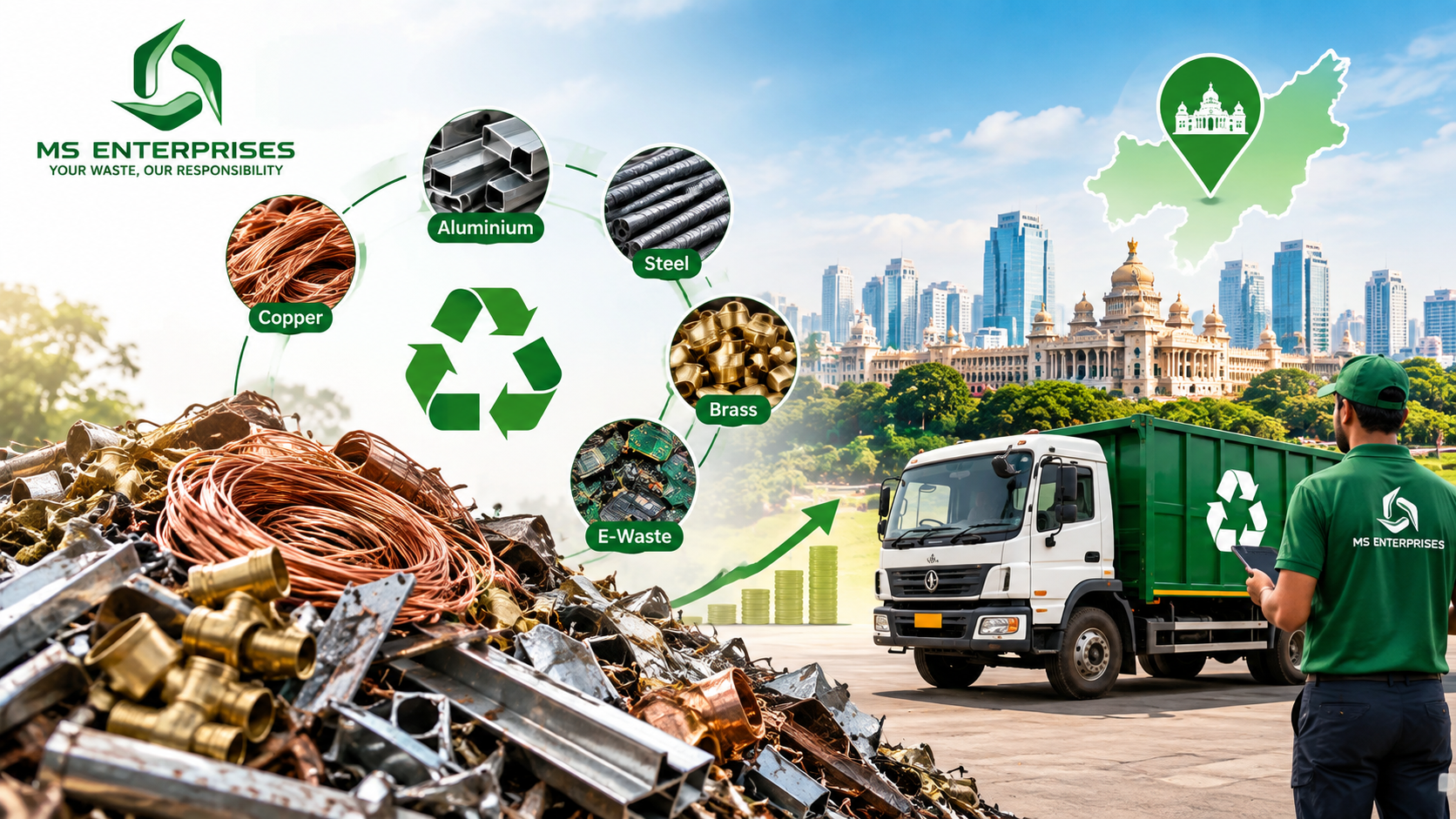
| Non-ferrous metal | Copper, brass, aluminium, stainless steel | Wiring, motors, utensils, pipes |
| Automobile scrap | Engines, gearboxes, body panels | End-of-life vehicles |
| Electronic and IT scrap | Circuit boards, wires, computer parts | Offices, IT companies |
| Battery scrap | Lead-acid batteries, UPS batteries | Homes, offices, backup power systems |
Since non-ferrous metals like copper and brass are constantly required for manufacturing and wiring, they often have the highest resale value. Sorting your items before a collection is scheduled may be made easier with a thorough explanation of what constitutes ferrous and non-ferrous junk.
How Do Metal Scraps and Recycling Actually Operate, Step-by-Step?
Scraps and metal recycling follow a regular procedure: collecting, sorting, processing, and resale to manufacturers that melt the metal down for reuse, regardless of whether the material comes from an industrial setting or a family kitchen. It is easy to understand why recycling correctly benefits both the environment and your finances when you are aware of each process.
- Collection. The recycler picks up scrap from your doorstep, factory, or office after you book a pickup slot.
- Sorting and grading. Items are separated by metal type, condition, and purity. Copper is separated from aluminium, and clean steel is separated from rusted metal.
- Weighing. The sorted scrap is weighed on a calibrated scale in front of the seller to keep the process transparent.
- Dismantling or shredding. Larger items such as vehicles or appliances are broken down to extract usable metal and remove non-metal components.
- Baling or bulk storage. Processed metal is compacted or stored in bulk, ready for transport to a smelter or processing unit.
- Resale to manufacturers. The metal is sold on to mills and foundries, where it is melted and reformed into new raw material for construction, automotive, or electronics industries.
This is also where the environmental value shows up. Melting recycled metal uses significantly less energy than mining and refining new ore, which is why organisations such as the Bureau of International Recycling track global recycled steel volumes as a measure of industrial sustainability.
How Are Scrap Metal Prices Determined?
Scrap metal prices are set primarily by the type of metal, its purity, current market demand, and the quantity being sold, and these rates change frequently based on global commodity markets. A recycler cannot offer a fixed nationwide rate because the underlying commodity price shifts daily.
| Factor | Effect on Price |
| Metal type | Copper and brass typically pay more per kg than iron or steel |
| Purity and condition | Clean, unmixed metal earns a better rate than mixed or rusted scrap |
| Quantity | Bulk sales often unlock better per-kg rates than small quantities |
| Market demand | Prices track domestic and international commodity trends |
| Preparation | Pre-sorted, dismantled scrap is easier to process and price fairly |
Sorting your junk by kind of metal before the pickup and asking the recycler for the day’s rate instead of depending on a price you saw weeks ago can help you get an accurate quotation.
Before contacting scrap metal recyclers, what should you do?
A small amount of preparation prior to the day of collection speeds up the process and increases the price you get. Prior to scheduling a time slot, it is helpful to:
- Separate metal items from wood, plastic, and general waste
- Remove any personal data from electronics such as laptops or hard drives
- Keep large or bulky items like automobile scrap accessible for loading
- Note down an approximate quantity so the recycler can plan the right vehicle and team
- Ask whether the recycler provides a receipt or transaction record
Recyclers that publish clear guidance on what they take, from appliances to office furniture, make it easier to plan ahead and avoid a wasted trip.
Where Can You Find Trusted Scrap Metal Recyclers Near You?
The most reliable method of finding respectable scrap metal recyclers is to look for a business that has a real location, verifiable customer feedback, and an open scheduling process, as opposed to an unauthorised door-to-door collection. A little higher reported price from an unidentified source is not as important as reputation and consistency.
For instance, MS Enterprises has been providing doorstep pickup and same-day payment services to homes, businesses, and industries in Hyderabad since 2023. This service covers everything from AC scrap to computer and IT scrap. If you live outside of Hyderabad, it’s important to find out if your city is served by established recyclers before presuming that your options are restricted to unofficial purchasers.
What Are the Environmental Benefits of Metal Recycling?
Compared to mining and refining virgin ore, recycling scrap metal uses less energy to generate new metal, conserves natural resources, and decreases landfill trash. Each tonne of recycled steel or aluminium eliminates the need for new mining, transportation, and smelting.
The benefits extend across several areas:
- Resource conservation. Recycled metal reduces dependence on newly mined ore.
- Energy savings. Reprocessing scrap metal generally uses far less energy than primary production.
- Reduced landfill waste. Metal, batteries, and e-waste are diverted away from dumping grounds.
- Lower emissions. Less mining and refining activity means a smaller carbon footprint per tonne of usable metal.
- Circular economy support. Materials stay in use for longer instead of being discarded after a single life cycle.
This is also why proper channels matter for items like batteries and electronic scrap. Left unmanaged, these can leach harmful substances into soil and water, whereas a compliant recycler processes them through approved methods.
A Short Checklist for Selecting the Best Scrap Metal Recyclers
In order to avoid making a decision only on the basis of cost, it is helpful to go over a brief checklist before committing to a recycler.
- Transparent weighing: Do they use a calibrated scale to weigh the stuff in front of you?
- Fair, current pricing: Could they describe how the present rate stacks up against more recent market prices?
- Materials accepted: Do they accept only certain metals, or do they accept anything from battery scrap to electronic junk?
- Doorstep pickup: Will they come to your place at a prearranged time?
- Evidence of payment: Do they offer a transaction confirmation or receipt?
- Track record: Do they have a solid working history and sincere consumer reviews?
Generally speaking, a recycler that scores highly on all six criteria is a safer long-term partner than the lowest quotation you get.
Frequently Asked Questions
What distinguishes non-ferrous scrap metal from ferrous scrap metal?
Non-ferrous scrap, such as copper, brass, and aluminium, has no iron and typically costs more per kilogram. Ferrous scrap, on the other hand, contains iron, is magnetic, and includes things like steel and MS pipes.
Do recyclers of scrap metal pay more for larger quantities?
Indeed, because it is more economical to collect, sort, and transport bigger loads in a single pickup, many recyclers offer greater per-kilogram prices for bulk or industrial volumes.
Is it safe to sell used batteries and gadgets with scrap metal?
Since batteries and electronics include hazardous elements that require regulated processing rather than careless disposal, it is safe when the recycler is set up to handle these products through the appropriate channels.
On any given day, how is the price of scrap metal determined?
Before the material is weighed, the seller verifies that the price is determined by the type of metal, its purity, the amount given, and the current market demand for that item.
Does the weighing of the scrap need my presence?
In order to observe the item weighed on a calibrated scale and verify the quantity before payment is made, it is advised that you or someone acting on your behalf be there.
Can companies and manufacturers sell scrap to metal recyclers in large quantities?
Indeed, reputable recyclers frequently collaborate with workplaces, industries, and building sites to gather industrial-scale waste, such as car parts, IT equipment, and large amounts of ferrous or non-ferrous metal.
After the metal is sold to a recycler, what happens to it?
The metal is sold to smelters, mills, or foundries after it has been sorted and processed. There, it is melted down and transformed into raw materials used in electronics, car manufacture, and building.
Final Thoughts
Selling to scrap metal recyclers is one of the simplest ways to get rid of extra metal, get a little money again, and keep useful items out of landfills. Whether you are handling enormous quantities of industrial waste or getting rid of a single outdated item, it is much easier if you know what to sort, how pricing works, and what a trustworthy recycler should provide.
If you are in Hyderabad and ready to sell, you can request a pickup or browse the full list of accepted categories on the blog for more detailed guides on specific scrap types.